Home of the Econoclave®
Industrial autoclaves, built around your process.
The Econoclave®, the world’s most popular composite curing autoclave, plus autoclaves for glass, rubber, concrete, investment casting, and nuclear processing. Built by ASC since 1989.
Explore the components
The Econoclave®
The world’s most popular composite curing autoclave
The Econoclave brings together ASC engineering, a unique system design, quality materials, and streamlined manufacturing to give Tier 1, 2, and 3 manufacturers an energy-efficient aerospace autoclave. Paired with CPC controls, it delivers more capability than any other autoclave on the market.
A large production Econoclave can save tens of thousands of dollars a year in electricity, compressed air, and nitrogen compared with a conventional autoclave.
Why it performs
Smaller vessel, lower operating cost, better uniformity
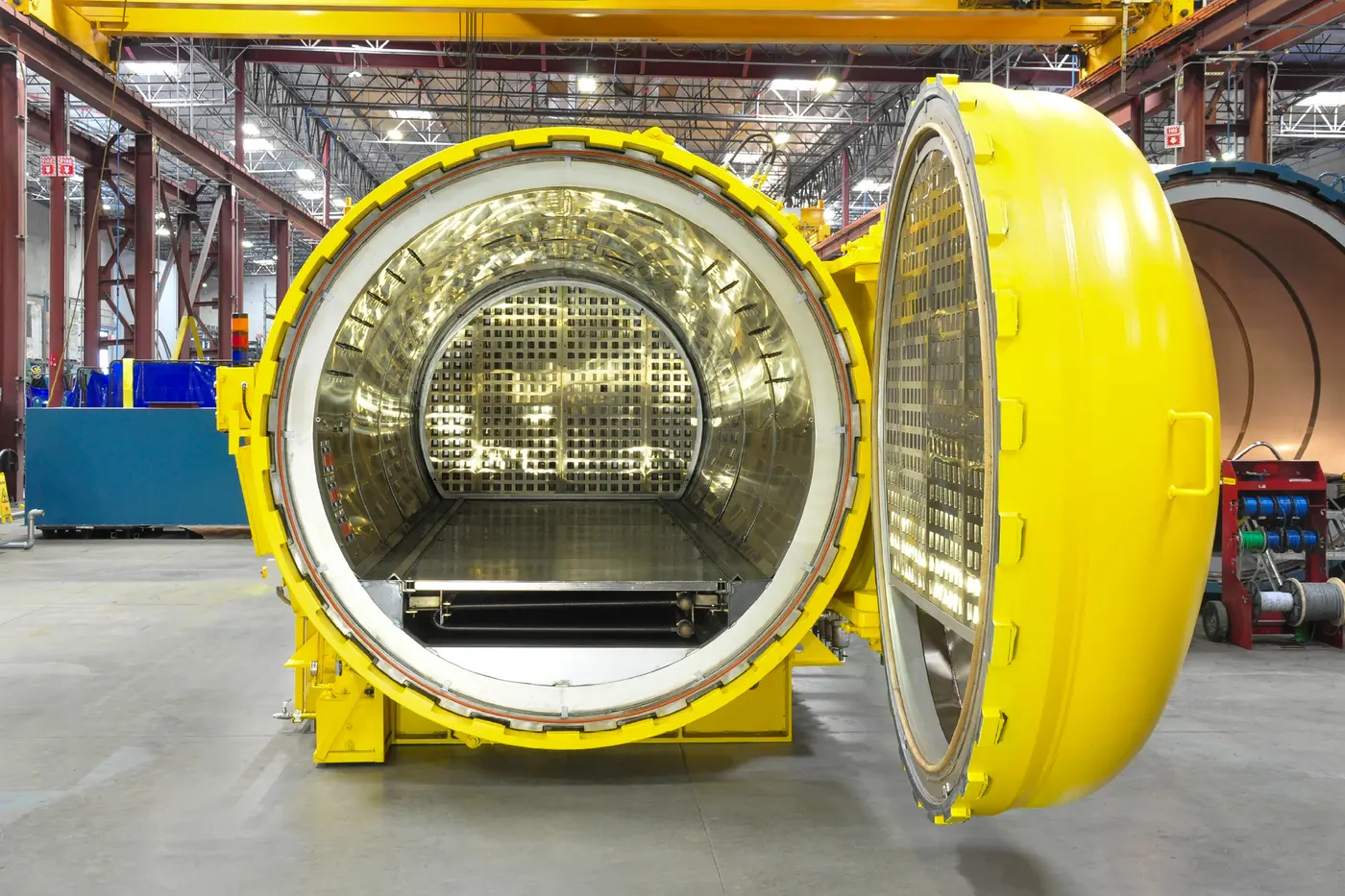
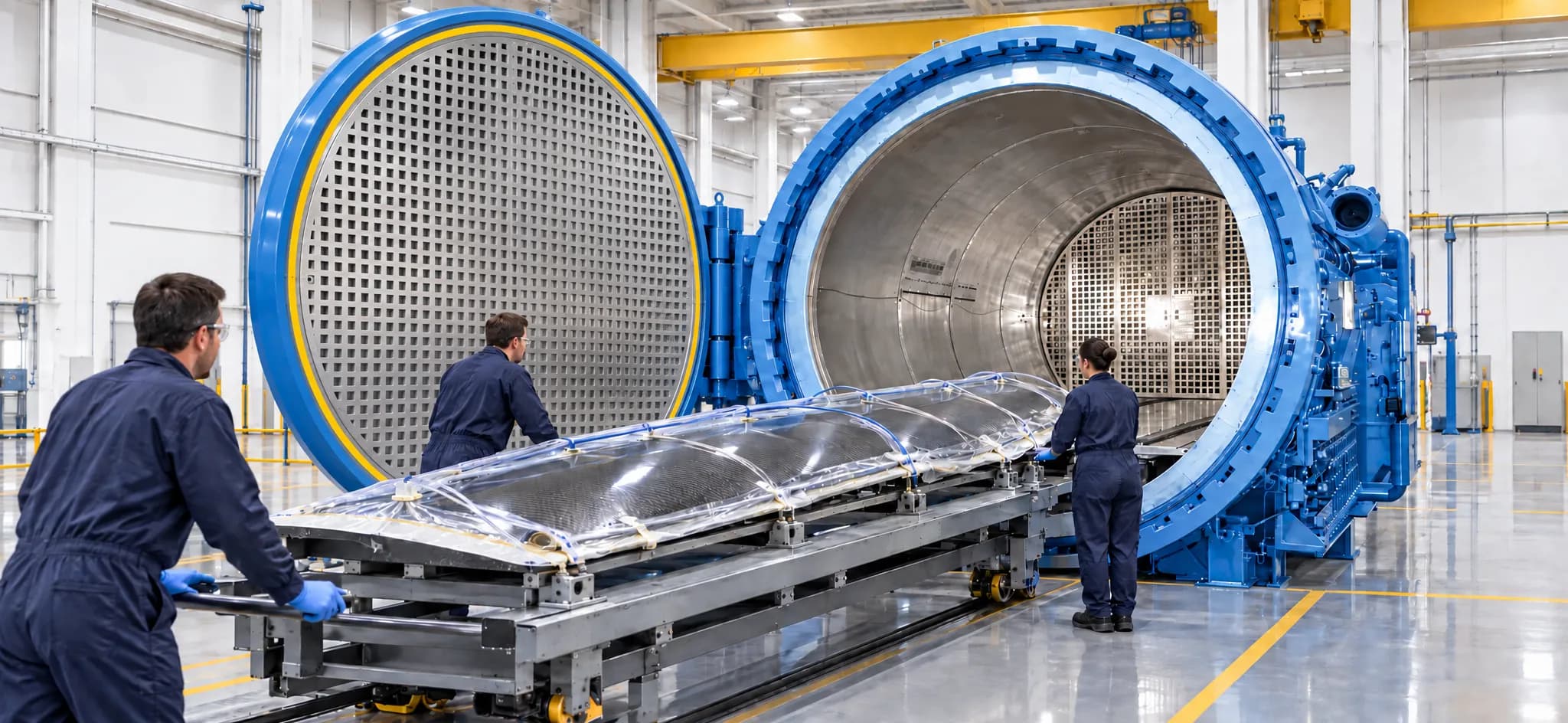
Heating and cooling under the floor and H-Slot airflow panels make the Econoclave shorter, cheaper to run, and even in temperature from the door to the rear wall.
20–30% less energy
Heaters and cooling coils sit under the floor, so the vessel is shorter and uses less electricity, compressed air, and nitrogen every cycle.
Near 100% usable volume
Proprietary H-Slot airflow panels balance flow front to rear, eliminating dead spots for uniform temperature along the whole length.
Installed in 1–2 weeks
Pumps, cooling tank, vacuum receiver, and controls are integrated on a skid and tested at our factory before shipment.
Stainless where it matters
Stainless-steel vacuum tubing, air lines, and heat exchangers. No plastic or copper tubing.
CPC controls standard
Every Econoclave ships with CPC, the composite processing control system used at more than 1,500 installations.
Built to any code
ASME and UL, CE/PED, China pressure vessel, Japanese Industrial Standards, and others.
Autoclave types
An autoclave for every process
We specialize in composite curing and bonding autoclaves, with decades of experience building autoclaves for glass, rubber, concrete, casting, and nuclear customers.
Composites autoclaves
Aerospace-grade curing and bonding for carbon fiber (CFRP) and other composite parts, used by leading aerospace, defense, and armor manufacturers.
Glass laminating
Autoclaves that cure laminated glass for architectural, automotive, and ballistic applications.
Dewaxing
Steam autoclaves that reach 100 psig in seconds to remove wax from investment casting shells without cracking them.
Vulcanizers
Horizontal or vertical rubber-curing autoclaves, from small parts to 17 ft earth-mover tires.
AAC concrete
Large-diameter steam autoclaves for curing autoclaved aerated concrete block and panels.
Nuclear sampling and transfer
ASME-certified containment autoclaves, hot boxes, and cold boxes for the nuclear fuel cycle.
Hydroclaves
Water-pressurized autoclaves that cure rocket nozzles and other dense composite parts at up to 1,500 psig.
Field-built autoclaves
Vessels too large to ship, fabricated and assembled on site by ASC field crews.
Buying options
Standard, in stock, used, or custom
Standard Econoclave models
Proven Econoclave sizes from 1 × 2 ft to 18 × 60 ft, plus metric sizes, with published specifications.
In stockNew autoclaves in stock
Econoclaves built and ready to ship for shorter lead times.
Pre-ownedUsed autoclaves
Pre-owned autoclaves currently available from ASC.
CustomCustom autoclaves
Engineered to your part, process, and code, including conventional annular-duct designs.
OptionsAvailable options
Code, power, cooling, vacuum, VacTrap™ resin traps, purge systems, carts, and installation.
CPC controls
Controls written for composite curing
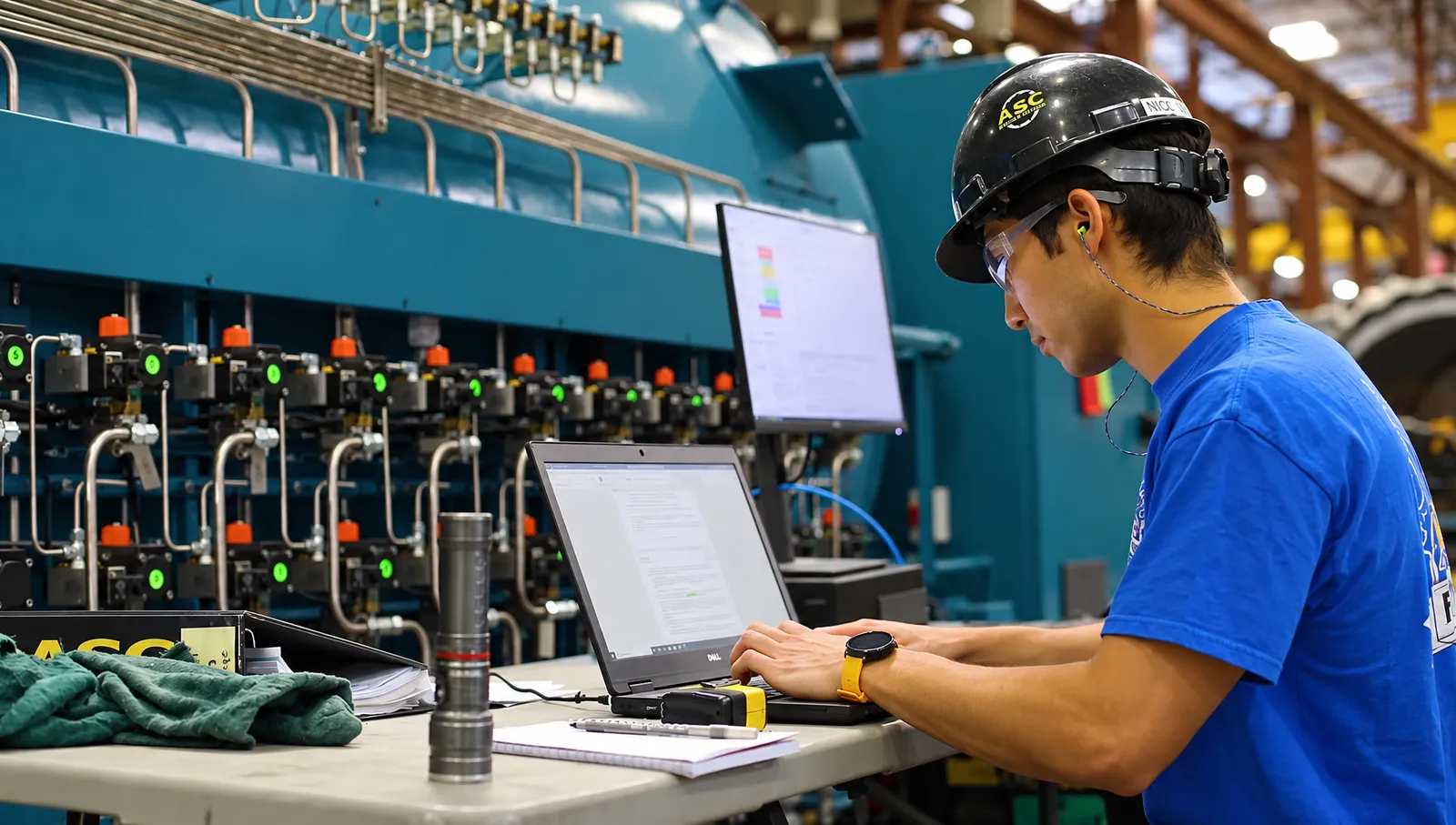
CPC (Composite Processing Control) is a PC-based control system designed specifically for autoclaves and ovens. First released in 1988 and updated every year since, it is the control system of choice at most of the world’s major aerospace composite manufacturers.
Automatic vacuum line control, automated quality analysis, SPC, and advanced reporting come standard on every new ASC autoclave.
FAQ
Autoclave questions
What is an industrial autoclave?
An industrial autoclave is a heated pressure vessel that processes parts under controlled temperature and pressure. Manufacturers use autoclaves to cure and bond composite parts, laminate glass, vulcanize rubber, cure concrete, and remove wax from casting molds.
What is the Econoclave?
The Econoclave® is ASC's composite curing autoclave, used by aerospace Tier 1, 2, and 3 manufacturers worldwide. Its under-floor heating and cooling and H-Slot airflow panels make it smaller and more energy-efficient than a conventional autoclave of the same working size.
How is the Econoclave different from a conventional autoclave?
Conventional autoclaves mount the heater and cooler behind the rear wall and move air through a radial duct, which needs a larger and up to 4 ft longer vessel. The Econoclave places them under the floor and uses the underfloor space to deliver air, reducing vessel size, energy use, and gas consumption.
What sizes and operating conditions can ASC build?
ASC has built shop and field-erected autoclaves from 1 ft diameter × 3 ft long to 30 ft diameter × 200 ft long, with operating conditions up to 2,000 psi and 1,500 °F.
When is a conventional autoclave a better choice?
When curing large-diameter cylindrical parts (over about 10 ft or 3 m) that need a floorless, rail-loaded vessel, or when a heavy load needs high heating and cooling rates in a length-limited vessel, ASC may recommend a conventional annular-duct design.
Contact
Spec your autoclave.
Tell us the part size, cure cycle, and pressure you need. An ASC engineer will recommend a standard model or a custom design.