Sublimation hot box
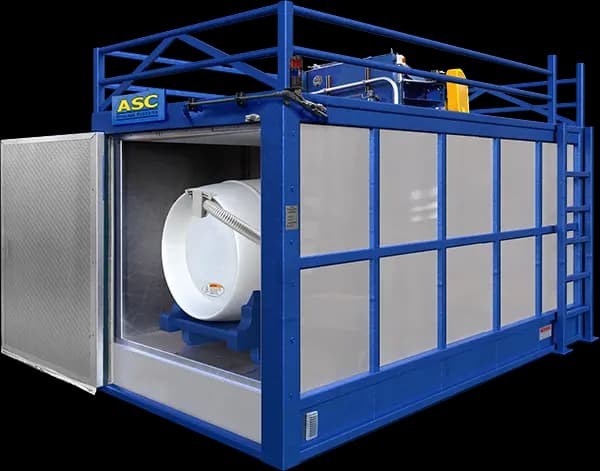
UF₆ hot boxes for sublimation.
Solid feed stations that turn UF₆ straight from solid to gas inside its cylinder, without melting it.
Explore the components
How it works
From solid to gas, inside the cylinder
At atmospheric pressure, uranium hexafluoride doesn't melt. It sublimes, passing straight from solid to gas at 56.5 °C (134 °F). It can melt only above its triple point, about 64 °C (147 °F) and 1.5 atm.
An ASC hot box, also called a solid feed station, uses that property. It warms the cylinder with circulating air while the process draws vapor off below the triple point, so the UF₆ leaves as gas and the cylinder never holds liquid or high pressure.
The cycle
Four steps from load to unload
Load the cylinder
A transporter rolls the cylinder in on its stillage onto the weigh frame, and the heat-traced pigtail is connected to the valve.
Purge and heat
With the door closed and locked, a dry-air purge clears the enclosure, then heated air circulates round the cylinder.
Feed the gas
Solid UF₆ sublimes and the vapor leaves through the valve and pigtail to the process, while the weigh frame tracks how much has gone.
Close out the cycle
At the target weight, heating stops and the valve closes. The pigtail is disconnected and the cylinder rolls out on its stillage.
Design
Built for safe, steady feed
Every hot box is engineered with the same expertise as ASC pressure vessels and autoclaves.
- Sublimes at 1 atm
- 56.5 °C (134 °F)
- Triple point
- 64 °C (147 °F) at about 1.5 atm (22 psia)
- Cylinders
- 30- and 48-series, including 30B, 30C, 48X, 48Y, and 48G
- Heating
- Electric, with circulating air
Solid to gas, never liquid
Holding the cylinder below UF₆'s triple point means the solid turns straight to vapor. There is no liquid UF₆ in the cylinder and its pressure stays low.
Heat from underneath
A fan at the rear drives air across the heaters and forward through a duct in the floor, so it rises round the cylinder from directly beneath it. Airflow is checked with CFD.
Weighed in place
The cylinder sits on a weigh frame with load cells, so the station always knows how much UF₆ has been fed.
Safe by design
An interlocked door stays locked while the box runs, with a release inside. The pigtail is heat traced and interlocked so a connected cylinder can't be moved.
Self-contained
Controls, power, heaters, and fan ship mounted and pre-wired on the box, with non-combustible insulation and a stainless interior.
CPC controls
CPC runs heating, purge, and interlocks from a swing-arm operator screen, records every cycle, and connects to plant systems.
FAQ
Hot box questions
What is a UF₆ hot box?
A hot box, also called a solid feed station or feed oven, is a heated enclosure for a UF₆ cylinder. It warms the cylinder with circulating air so the solid uranium hexafluoride inside sublimes, and the gas is drawn off through the cylinder valve to the process.
Why sublimate UF₆ instead of melting it?
Below its triple point, about 64 °C and 1.5 atm, UF₆ goes directly from solid to gas. Feeding vapor this way keeps the cylinder at low pressure and avoids liquid UF₆, which needs higher temperature and pressure and is held only in containment such as an autoclave.
What is the difference between a hot box and a UF₆ autoclave?
A UF₆ autoclave is an ASME pressure vessel that seals the cylinder in containment, so it can also melt the UF₆ for sampling. A hot box heats the cylinder for sublimation only. ASC builds both, and its autoclaves can sublimate UF₆ as well.
Which cylinders can an ASC hot box hold?
ASC hot boxes are built for standard 30- and 48-series UF₆ cylinders, including 30B, 30C, 48X, 48Y, and 48G. Interchangeable stillages let one box take several cylinder types.
Can a hot box work with a cold box?
Yes. A hot box sublimes UF₆ out of one cylinder and a cold box desublimes it into another, which moves the material between cylinders without ever melting it.
Contact
Plan your hot box.
Tell us your cylinders, feed rates, and facility layout. Our engineers will size a hot box or a bank of stations.