The Econoclave®
Smart design leads to great things.
The world's most popular composite curing autoclave: smaller, more efficient, and more capable than a conventional autoclave, with CPC controls standard and 20 to 30% lower energy use.
Explore the components
The Econoclave difference
Same working size, smaller vessel
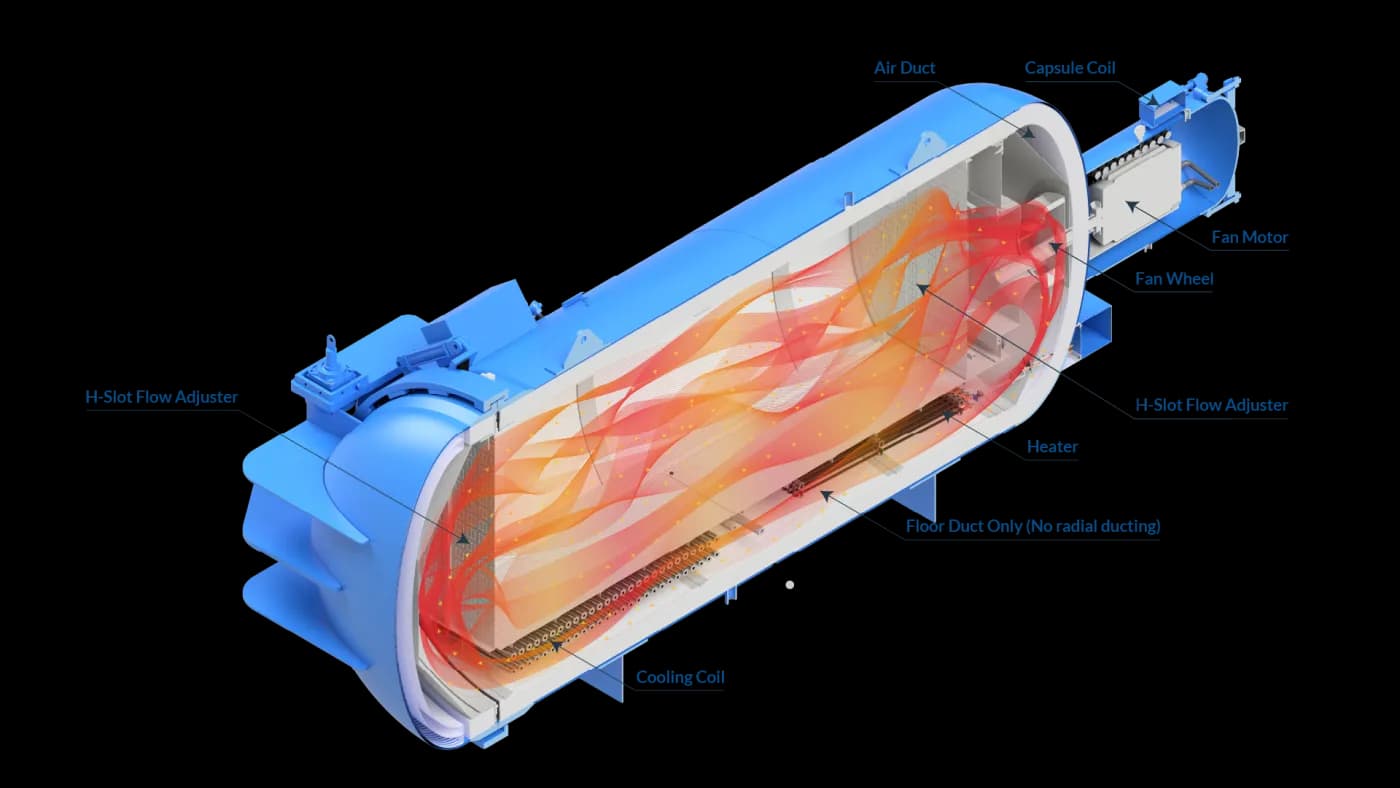
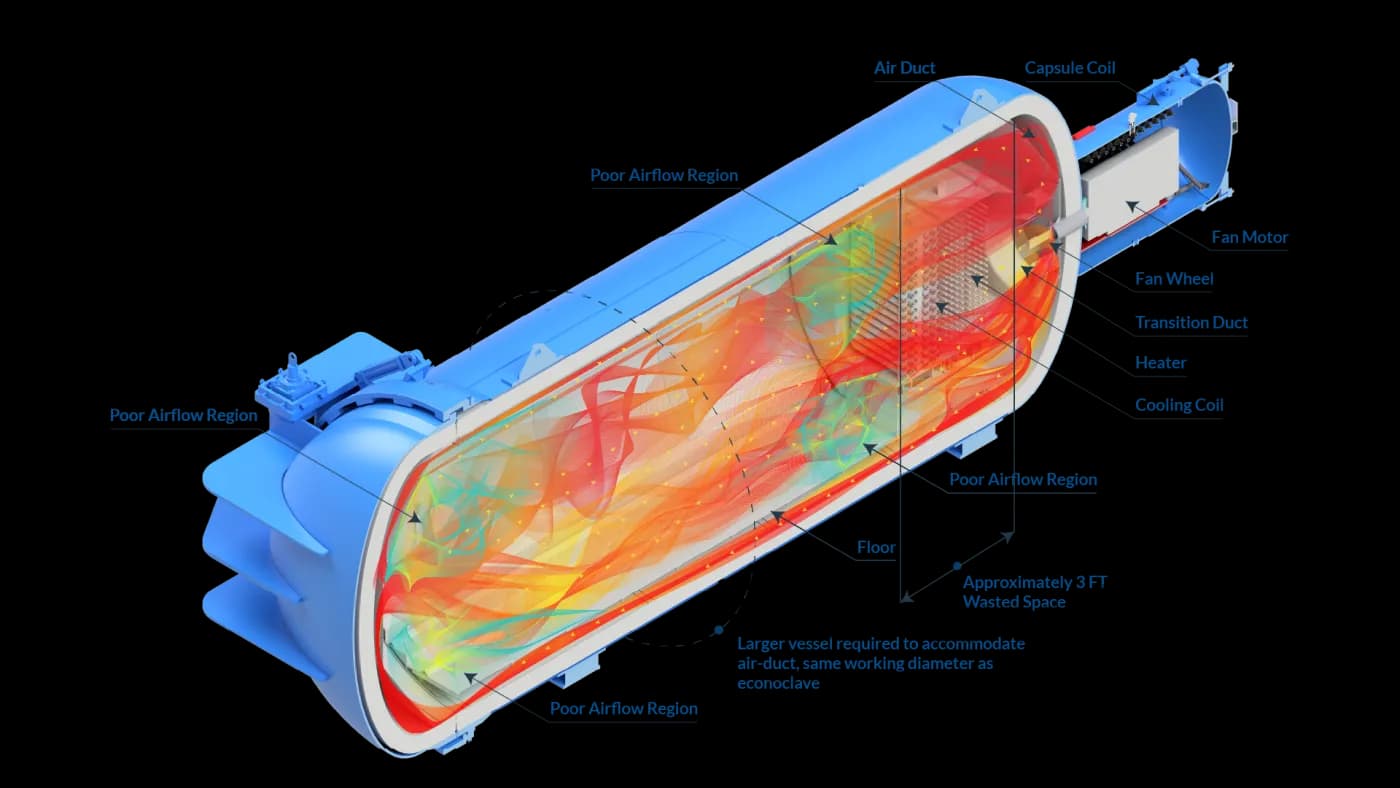
The biggest differences between an Econoclave and a conventional autoclave are where the heating and cooling live, and how air reaches the parts.
Design
Why it performs
The H-Slot difference
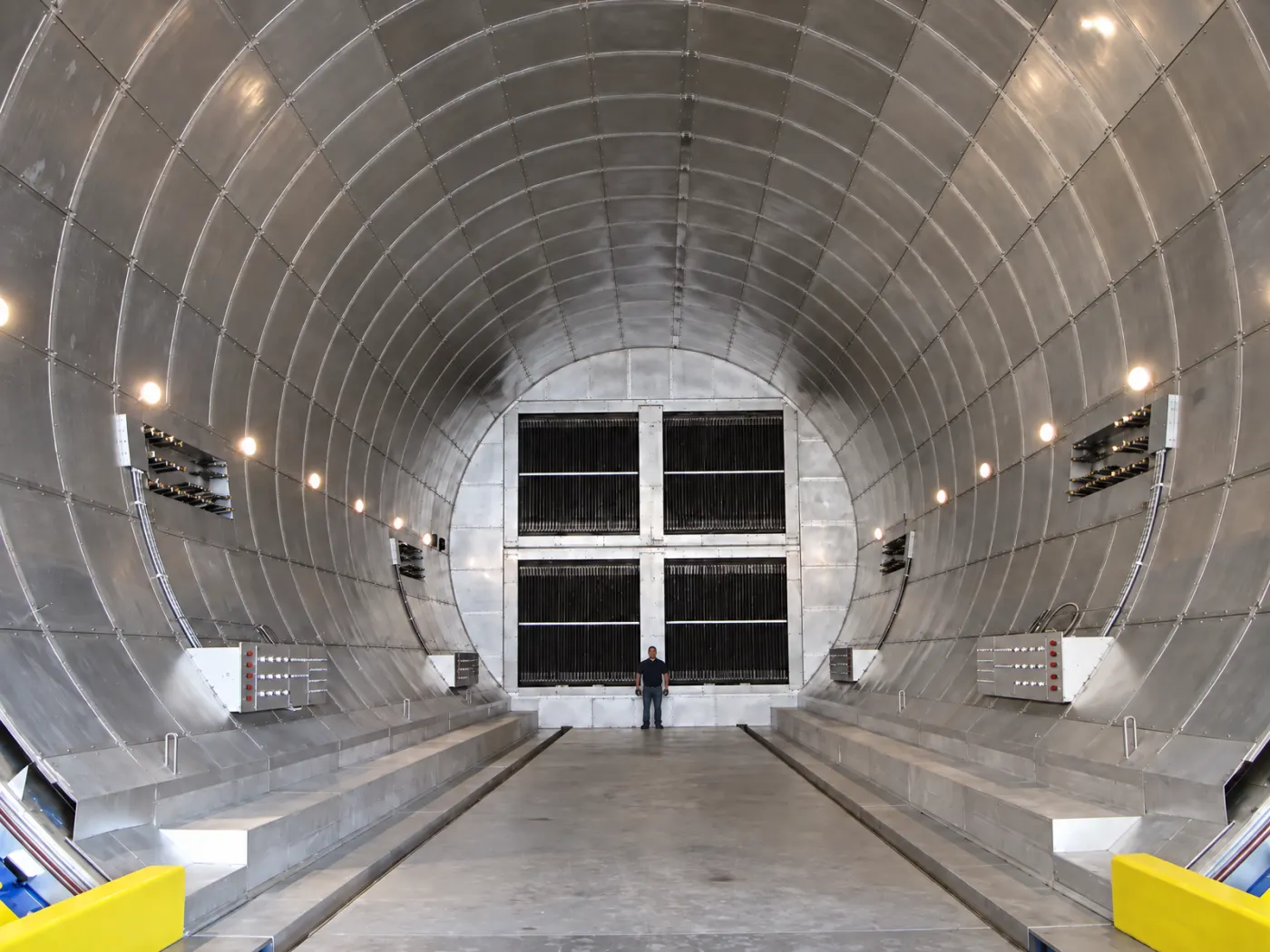
Proprietary full-area H-Slot panels balance and straighten airflow at the front and rear of the working volume. No dead spots means near 100% usable volume and uniform heating and cooling down the whole length.
Floor-mounted heater and cooler
Conventional autoclaves put the heater and cooling radiator behind the rear wall, adding up to 4 ft (1.4 m) of vessel. Moving them under the floor shortens the vessel and cuts heating and gas use every cycle.
Fully integrated assembly
Cooling tank, pumps, vacuum receiver, and control and power enclosures ship on one tested skid. Installation and startup usually take one to two weeks.
High-quality materials
No plastic or copper tubing. Vacuum tubing, air lines, and heat exchangers are stainless steel.
Advanced capabilities standard
CPC control, automatic vacuum line control, automated quality analysis, advanced reporting, and SPC come with every new autoclave.
Built to any code
ASME and UL in the US, CE/PED in Europe, China pressure vessel authority, Japanese Industrial Standards, and others.
Market designed
An Econoclave for every market, in any size
ASC designs Econoclave versions for aerospace composites, ballistics and armor, glass laminating, and nuclear markets. We have built shop and field-erected units from 1 ft diameter by 3 ft long to 30 ft diameter by 200 ft long, at up to 2,000 psi and 1,500 °F.
Every Econoclave is designed to your processing and operating specifications, and built to meet or exceed them.
FAQ
Econoclave questions
What is the Econoclave?
The Econoclave® is ASC Process Systems' composite curing autoclave, used by aerospace Tier 1, 2, and 3 manufacturers worldwide. It combines ASC engineering, a unique system design, and CPC controls in an energy-efficient, high-performance autoclave.
What makes the Econoclave different from a conventional autoclave?
Floor-mounted heating and cooling replace the radial air duct and rear-mounted coils of a conventional autoclave, and ASC's H-Slot airflow system gives uniform temperature along the working length. The result is a smaller vessel that costs less to heat, cool, and pressurize.
How does the Econoclave save on operating costs?
Its smaller vessel uses less electricity, compressed air, and nitrogen every cycle. Under-floor coils reduce energy demand by 20 to 30%, and a large production Econoclave can save tens of thousands of dollars a year compared with a conventional autoclave.
What sizes can the Econoclave be built in?
ASC has built shop and field-erected autoclaves from 1 ft diameter by 3 ft long to 30 ft diameter by 200 ft long, with operating conditions up to 2,000 psi and 1,500 °F. Standard models cover the most common sizes.
Is the Econoclave always the right choice?
Usually, but not always. For large cylindrical parts over about 10 ft (3 m) in diameter that need a floorless, rail-loaded vessel, or heavy loads with high heating and cooling rates in a length-limited vessel, ASC may recommend a conventional annular-duct design.
Next steps
Choose your Econoclave
Contact
Spec your Econoclave.
Tell us your part size, cure cycle, and pressure. An ASC engineer will recommend a standard model or a custom design.